
Three cities, three stages, three firsts: on the value of uncertainty and the beauty of human interaction

An old professor sent me a message on LinkedIn recently.
He said he’d been following my recent posts and that from the outside, it looked like things were going really well for me. Then he added a line I wasn’t expecting: “I hope that’s truly the case.”
I re-read the line between pauses as I crafted my response because it felt…thoughtful.
That’s not a trait I come across often in a digital era driven by performance and packaging, especially on LinkedIn, where everyone is “excited to share” their next win. I appreciated someone checking in on the real.
So is that truly the case? What have I really been up to?
The truth is, 2026 came in fast.
I have not spent a full month at home since August 2025. Over the last few months, I've had the opportunity to guest lecture at Michigan State University, co-present at the Quirk’s Event in Dallas, and moderate a panel at the VIBE Conference in Atlanta.
What looks impressive from the outside has included back-to-back flights, packing before getting a chance to unpack, walking to the room number from my previous hotel at the new one, a spontaneous conversation about American voting history with a stranger at the hotel bar that somehow lasted until 1 a.m., and a DoorDash order from CVS at 3 am because my body finally decided to lodge a formal complaint and shut down the night before a presentation. Alas, the show, as they say, must go on.
Three cities. Three stages. Three firsts. Here’s what that looked like from the inside.
First stop: East Lansing
My first guest lecture at MSU happened during the pandemic through a screen. This time, I got to engage with students face-to-face. There's a vibrance to a room of intelligent students eager to jump into the discussion and build on another student’s answer.

We talked about what it takes to break into the market research industry today. Curiosity. Adaptability. Grit. We worked through case studies together and unpacked what adding value to clients looks like in an AI era.
One of my favorite parts was a group exercise where students had to personify different AI platforms they were randomly assigned. Because AI is evolving so quickly, it is important to understand not just what these platforms do, but who they are becoming and how we (users) want to engage with them:
What are the tradeoffs of only relying on one platform?
Most of us don't have just one friend. Why would we only have one thought partner?
Before wrapping up, I gave the students one piece of unsolicited advice: stay curious. In life, in this industry, and especially in this political climate. Don’t be quick to write each other off. Ask questions in a kind and curious way to gain perspective, and you might even help someone grow!
Somehow, nearly two hours flew by, and we ran out of time for Q&A, so I stayed behind speaking with students one-on-one as they shuffled out of the classroom.
It was my first time guest lecturing in person.
Next stop, Dallas
A few weeks later, I was in Dallas co-presenting with my colleague Tal Oren at the Quirks Event on a topic that seems to follow me everywhere these days, "The Human Edge in an AI Era". What do humans bring to the table now that a lot an be done by AI? We started by tracing the familiar arc of technological anxiety repeated throughout history: the machine will make the human obsolete.

Tal introduced me to the idea of “friction-maxxing” while we were preparing our presentation, and the concept stayed with me long after. For years, I have prided myself on eliminating friction. In fact, when a therapist once asked me to choose core values from a list, I wrote ‘optimization’ in the corner instead. I am intentional about protecting and preserving my focus, time, and energy to have more to spend on what I want. So what do you mean I should reintroduce friction?
Well, friction allows for growth.
We shared with the audience that there is something deeply unfulfilling about receiving answers without ever wrestling with the questions first. Or sitting on the other side of the screen, staring at an output you have no relationship with and no context for. It might be right, but you feel so disconnected from it.
It was my first time co-presenting at a conference.
Final destination: Atlanta
A week after Dallas, I was in Atlanta at the second annual VIBE conference, a gathering for Black market research professionals.
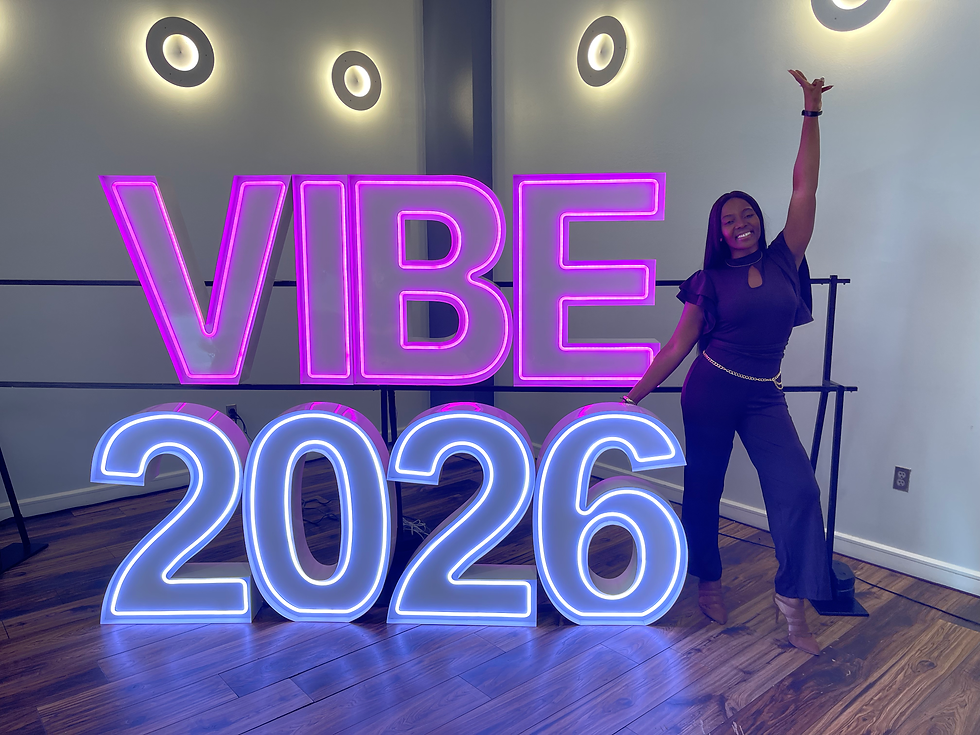
One of our Talk Shoppe clients had invited me to moderate a 45-minute panel on the future of insights, which could have easily turned into another generic conversation about AI.
Instead, we intentionally widened the lens:
What happens to the consumer packaged goods (CPG) and quick service restaurant (QSR) industries as GLP-1 medications become more widely accessible?
How do we make sure AI is relieving pressure on underrepresented communities rather than replicating the biases that have always existed in data?
When companies tell their teams to use AI to "do more with less" and the word ‘people’ is silent at the end of that sentence. Do more with less people. What does that mean for the human elements of research?
My brilliant panelists sparked conversations far bigger than 45 minutes could contain and left the room buzzing with ideas.
It was my first time moderating a panel at a conference.
Reflections from home
This season of firsts has felt like a real-life exercise of friction-maxxing, where the process changed me more than the outcomes ever could. Each new venture came with uncertainty, and I had a choice between staying comfortable at home or growing into the kind of speaker I want to become.
Leaving room for magic is friction. I could work from a tight script to avoid uncertainty, but I never will. The richest moments in every room I've been in this year came from somewhere unplanned: a student's comment, a panelist's tangent, a thread the audience pulled that suddenly pulled the quietest person in the room into the conversation.
That is the beauty of human interaction: you never fully know where it might go.
Honestly, I hope we never lose that.





Such a great read. Loved hearing about all the speaking engagements and I am sure there will be be more in the future. “Leave room for magic” I love that and will take that with me when I walk into rooms.